
Gyutou Knife 210 mm Kanetsugu Zuiun Kiwami SPG2 - DLC Coating
Code: 9505Related products


Product detailed description
Kanetsugu ZUIUN KIWAMI Kiritsuke/Chef 210 mm SPG2 DLC Coating
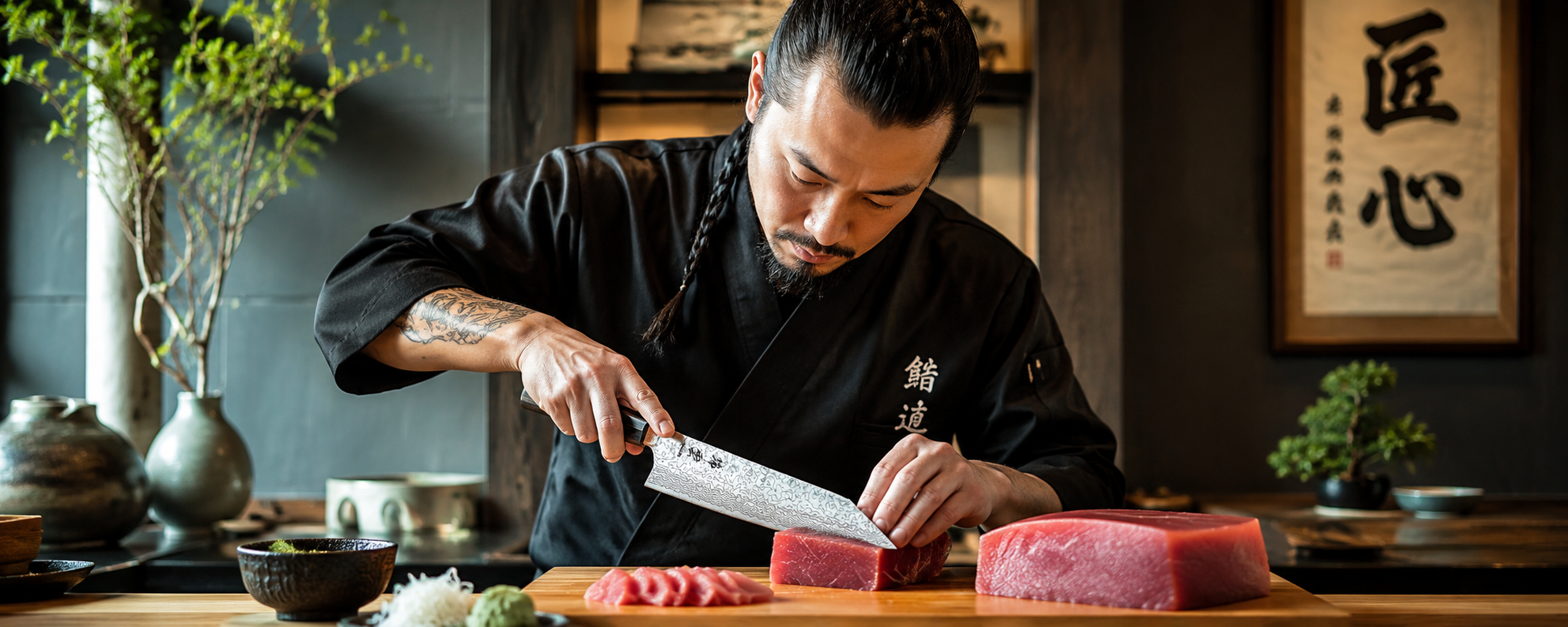
The Kanetsugu ZUIUN KIWAMI Kiritsuke/Chef 210 mm is a luxury Japanese chef's knife designed for chefs who want maximum cutting performance, precision, and versatility in the kitchen. The long blade with a distinctive Japanese sword-style tip combines the functions of a Chef, Gyuto, and Kiritsuke knife. SPG2 powder steel, a 62-layer Damascus construction, DLC coating, and a Hamaguriba convex grind create an exceptionally sharp and perfectly balanced knife with a smooth cut, high control, and a luxurious appearance.
Knife Specifications
| Parameter | Value |
|---|---|
| Knife Type | Kiritsuke / Chef / Gyuto |
| Blade length | 210 mm |
| Total length | 355 mm |
| Handle length | 135 mm |
| Weight | 171 g |
| Steel | SPG2 / SG2 Powder Steel |
| Hardness | R63 ±1 Rockwell |
| Construction | 62 layers of Damascus steel + SPG2 core |
| Grinding | Hamaguriba – Japanese convex grind |
| Heat treatment | Sub-Zero process, deep cooling of the blade to -70 °C or lower |
| Surface | DLC Coating – Diamond Like Carbon |
| Handle | 8-sided ebony-colored pakkawood |
| Manufacturing | Seki City, Japan |
| Product Code | 9505 |
| EAN | 8595705404717 |
#ShowMore#
What is the Kiritsuke/Chef 210 mm suitable for?
The Kiritsuke/Chef 210 mm is a versatile Japanese chef's knife for demanding everyday work. Thanks to its 210 mm blade length, it handles larger quantities of ingredients, precise vegetable slicing, meat portioning, fish filleting, and herb preparation . The raised tip and blade point modeled after a Japanese sword allow for precise work with the tip, decorative carving, and detailed finishing cuts.
The blade shape is also suitable for rocking cuts of herbs, vegetables, and nuts. The wider, versatile profile gives the knife stability, while the thin Japanese geometry and Hamaguriba grind ensure a smooth cut with minimal resistance.
| Type of use | Why the Kiritsuke/Chef is ideal |
|---|---|
| Vegetables | The long blade allows for quick and precise slicing of larger quantities of ingredients. |
| Boneless meat | The sharp SPG2 core easily cuts through muscle tissue and creates a clean cut. |
| Fish and sushi | The thin geometry and long blade facilitate a gentle and controlled cut. |
| Herbs and nuts | The higher-set tip is suitable for rocking cuts. |
| Decorative work with the tip | The Japanese sword-style tip is suitable for precise finishing cuts and carving. |
| Fruit | The blade glides smoothly through both soft and firmer fruits. |
| Everyday professional cooking | The versatile shape handles most kitchen tasks. |
The Kanetsugu ZUIUN KIWAMI Kiritsuke/Chef 210 mm performs with great confidence, speed, and precision when slicing. The long blade offers plenty of room for smooth cuts, while the Japanese sword-style tip allows for detailed work. The DLC coating, Hamaguriba grind, and hard SPG2 core help the blade glide through ingredients with minimal resistance.
Why is SPG2 one of the best Japanese steels?
SPG2, also known as SG2, is among the most advanced Japanese powder steels used in premium kitchen knives. Thanks to its very fine microstructure, it achieves exceptional sharpness, high hardness, and long-lasting edge retention.
Compared to standard stainless steels, SPG2 offers a finer grain , lower cutting resistance, and longer intervals between sharpening. At the same time, a hardness of around R63 HRC allows for very fine blade sharpening without losing edge stability.
| SPG2 Properties | Practical Benefits |
|---|---|
| Extreme sharpness | The very fine microstructure allows for exceptionally precise sharpening. |
| Long-lasting edge | The knife retains its high sharpness significantly longer than standard stainless steels. |
| Edge stability | A hardness of approximately R63 HRC helps maintain a precise cut even with intensive use. |
| Lower cutting resistance</ td> | The thin blade geometry allows for smooth cutting through ingredients. |
| Premium cutting performance | Perfect for professional work, vegetables, meat, fish, and detailed cuts. |
Sub-Zero process – higher hardness and toughness
The blade undergoes special deep cooling to a temperature of -70 °C or lower. This Sub -Zero process promotes high hardness, material stability, and improved blade toughness.
| Advantages of the Sub-Zero process | Benefits for the knife |
|---|---|
| Higher hardness | The blade retains its fine edge better. |
| Better toughness | The blade is more stable during daily use. |
| Longer edge retention | The knife requires less frequent sharpening. |
| More stable steel structure | Greater reliability for professional work. |
Hamaguriba – traditional Japanese convex grind</ h2>
Kanetsugu ZUIUN KIWAMI uses the traditional Japanese Hamaguriba convex grind, inspired by the geometry of Japanese swords. Unlike a flat grind, the blade has a gently rounded profile, allowing it to glide more smoothly through ingredients and create a clean cut with less resistance.
| Advantages of Hamaguriba | Benefits during use |
|---|---|
| Lower cutting resistance | Smoother and easier cutting. |
| Cleaner cut | Less damage to the structure of vegetables, meat, fish, and herbs. |
| Greater blade stability | Better resistance to micro-chipping. |
| A luxurious feel while working | Silky-smooth glide through ingredients. |
DLC Coating – modern protective surface
DLC coating, or Diamond-Like Carbon, is a thin protective layer of carbon with properties similar to diamond. It gives the blade a luxurious dark appearance, reduces friction during cutting, and minimizes food sticking to the blade surface.
| DLC Surface Property | Benefit |
|---|---|
| Lower friction | The blade cuts through ingredients more easily. |
| Less sticking | Food sticks less to the blade. |
| Higher surface durability | Better protection against wear. |
| Chemical resistance | Greater protection when in contact with more aggressive ingredients. |
| Luxurious appearance | Elegant dark premium finish. |
62 layers of Damascus steel
The blade features a multi-layered Damascus construction with 62 layers of stainless Damascus steel. The hard SPG2 core is protected by outer layers that increase the blade’s stability, toughness, and overall durability.
| Damascus property | Advantage |
|---|---|
| Multi-layered construction | Greater blade stability. |
| Hard cutting core | Extreme sharpness and long-lasting edge. |
| Luxurious steel pattern | Unique visual character of each knife. |
| Protective outer layers | Improved toughness and core protection. |
Ergonomic Japanese Handle
The Japanese-style 7-sided Shichikaku handle provides perfect control over the cut and effective support while slicing. It is made of ebony-colored Pakka-wood, which is durable, dimensionally stable, and suitable for long-term use in the kitchen.
| Advantages of the handle | Benefits |
|---|---|
| Natural ergonomic grip | Less hand fatigue during prolonged use. |
| Polygonal profile | Greater stability and control of the knife. |
| Ebony-colored Pakka-wood | Durable, dimensionally stable, and elegant material. |
| Decorative tang | A subtle Asian detail highlighting the premium craftsmanship. |
| Perfect balance | More comfortable work and less hand fatigue. |
What makes the ZUIUN KIWAMI series exceptional?
| Series Feature | What It Offers |
|---|---|
| SPG2 Powder Steel | Extreme sharpness and long-lasting edge retention. |
| Hamaguriba | An exceptionally smooth and clean cut. |
| DLC Coating | Lower friction, higher durability, and a luxurious appearance. |
| 62 layers of Damascus steel | Greater structural stability and elegant pattern. |
| Handle | Secure and ergonomic grip. |
| Sub-Zero process | Greater hardness, toughness, and blade stability. |
It is a precision Japanese tool designed for maximum control, a clean cut, and an exceptionally smooth feel when working. The combination of SPG2 Powder Steel, DLC coating, Damascus construction, and the Hamaguriba convex grind creates an exceptionally sharp knife with a very elegant character.
Who is this knife for?
| User Type | Why They'll Love This Knife |
|---|---|
| Professional chefs | Long, versatile blade, maximum sharpness, and high control for everyday work. |
| Lovers of Japanese knives | Premium SPG2 steel, DLC coating, Damascus construction, and Japanese craftsmanship. |
| Discerning home cooks | A luxurious all-purpose knife for vegetables, meat, fish, herbs, and fruit. |
| Chefs with an eye for detail | The Japanese sword-style tip is ideal for precise finishing cuts and decorative work. |
| Sushi chefs | Clean and smooth cuts of fish, vegetables, and herbs. |
| BBQ and steak enthusiasts | Suitable for slicing and portioning boneless meat as well as serving cuts. |
| Collectors | The luxurious ZUIUN KIWAMI series with a distinctive dark DLC finish. |
FAQ – Frequently Asked Questions
What type of steel is used in the knife?
The knife uses Japanese SPG2 / SG2 powder steel with a hardness of approximately R63 ±1 HRC.
What is the Kiritsuke/Chef 210 mm suitable for?
The Kiritsuke/Chef is a versatile Japanese chef's knife suitable for vegetables, boneless meat, fish, fruit, herbs, rocking cuts, and decorative work with the tip.
Why does the Kiritsuke have a Japanese sword-style tip?
The distinctive tip allows for precise work, detailed finishing cuts, and decorative carving of ingredients.
What does DLC coating mean?
DLC, or Diamond-Like Carbon, is an extremely hard protective coating that reduces friction, prevents food from sticking, and gives the blade a luxurious dark finish.
What does Hamaguriba mean?
Hamaguriba is a traditional Japanese convex grind inspired by Japanese swords. It helps achieve an exceptionally smooth and clean cut.
What is the Sub-Zero process?
The Sub-Zero process involves deep-freezing the blade to a temperature of -70 °C or lower, which promotes high hardness and toughness in the blade.
Is the knife suitable for professional chefs?
Yes. The Kiritsuke/Chef 210 mm is highly suitable for professional culinary use, versatile cutting, preparing vegetables, meat, and fish, and precise serving cuts.
How should I properly care for the knife?
Always wash the knife by hand, dry it immediately, and store it safely in a sheath, stand, or on a magnetic strip. Never wash it in the dishwasher.
Can I use the knife to cut bones or frozen foods?
No. The hard Japanese SPG2 blade is designed for precise cutting, not for chopping bones, frozen foods, or hard materials.
Recommendations and Maintenance for Japanese Knives
Never wash the knife in the dishwasher. Wash it by hand after use and dry it immediately.
Do not use the knife as a pry bar and do not bend the blade. The knife is intended solely for cutting.
Protect the blade and cutting edge from drops, impacts, and contact with hard materials.
If you will not be using the knife for an extended period, lightly coat it with oil and wrap it in a cloth or newspaper.
Store the knife in a safe place, ideally in a protective sheath, stand, or on a magnetic strip.
Keep the kitchen knife out of reach of children and exercise extreme caution when handling it.
Notice
Each knife is made from natural materials. Every piece of steel and wood is unique, so the final appearance of the knife may vary slightly from the product photo. The knife you receive will be of the same high quality and carefully crafted.
Sharpening a kitchen knife
To maintain maximum sharpness, we recommend regularly maintaining your Japanese kitchen knife using high-quality water whetstones, diamond whetstones, steel and stroping leathers.
Water stones are among the gentlest and most effective ways to sharpen Japanese knives. They allow for precise restoration of the edge and are suitable for both regular maintenance and complete sharpening. Diamond stones excel in high efficiency and rapid material removal, making them ideal even for harder types of Japanese steel.
Honing steels are primarily used for ongoing alignment and straightening of the edge during normal knife use. For fine polishing and achieving extreme sharpness, we also recommend using stroping leather.
If you are unsure about sharpening, please contact us. We will professionally sharpen your knives according to your individual preferences. We also regularly organize knife sharpening courses.
Cleaning a Kitchen Knife
After each use, wash the knife by hand in lukewarm water, dry it with a soft cloth, and store it in a safe place. Residues of harsh ingredients can cause rust-like stains on the blade’s surface. This is not always corrosion of the blade itself, but often food particles or debris from the surrounding environment that have become lodged on the blade. To remove them, you can use, for example, baking soda mixed with a little water into a fine paste and an old cork.
Dellinger Warranty
Products supplied by Dellinger come with a 100% satisfaction guarantee. We carefully inspect every product and guarantee its high quality, reliability, and long service life. We provide a lifetime warranty for hidden defects. If you have any questions, our team is fully at your disposal and will be happy to with selecting, using, and caring for the product.
Kanetsugu ZUIUN KIWAMI Kiritsuke/Chef – a precision Japanese knife without compromise
The Kanetsugu ZUIUN KIWAMI Kiritsuke/Chef 210 mm combines traditional Japanese craftsmanship, modern SPG2 powder steel, 62-layer Damascus steel, DLC coating, Sub-Zero heat treatment, and a Hamaguriba convex grind.
The result is an exceptionally sharp, elegant, and perfectly balanced all-purpose chef’s knife that offers a smooth cut, high control, and luxurious performance for both everyday and professional kitchen work.
Additional parameters
| Category: | Zuiun KIWAMI SPG 2 Damascus steel DLC |
|---|---|
| Warranty: | 2 years |
| Weight: | 0.171 kg |
| EAN: | 8595705404717 |
| čepel: | ocel damašková |
| ? délka ostří: | 201-250 mm |
| typ rukojeti (střenky): | oktagonal (8mi hran) |
| typ nože: | Chef / Gyuto |
| série: | Kanetsugu Zuiun Kiwami SPG2 - DLC Coating |
| production: | Japan |
Kanetsugu Seki Japan – The tradition of Japanese swords in modern cuisine
Kanetsugu Seki Japan is a traditional Japanese knife brand originating in the city of Seki, which is considered the centre of Japanese sword making. Its history dates back to the 14th century, when famous samurai swords were manufactured here. It is this sword-making tradition that the Kanetsugu brand has brought to the world of kitchen knives. The company was officially founded in 1918 by master craftsman Matsujiro Kanetsugu, who continued the legacy of the legendary 14th-century swordsmith Kanetsugu Naoe. Now in its fourth generation, the modern company combines traditional craftsmanship with modern production technologies, while still priding itself on hand sharpening, polishing and precision workmanship.
#showmore#
What makes Kanetsugu knives so special?
A combination of tradition and technology: Hand-finished blades, many with a Damascus pattern or made from modern powder steels (e.g. SG2), combine aesthetics and performance.
Sharpness and durability: Kanetsugu knives are known for their extreme sharpness, high hardness and long cutting life.
Precision manufacturing: Kanetsugu emphasises ergonomics, balance and perfect control when cutting.
Japanese design: Elegant, traditional and modern blade and handle shapes with an emphasis on aesthetics and user comfort.
Model series and uses
Popular series include:
Zuiun – top-of-the-range models made from SG2 powder steel with a Damascus pattern and a beautiful mirror finish.
Saiun – an elegant series with classic Damascus steel.
Pro M, Pro J, Pro S – professional series for chefs and demanding households.
Kanetsugu knives are manufactured for various uses – from versatile Gyuto knives to small Petty knives and traditional Kiritsuke or Nakiri knives.
Conclusion
Kanetsugu Seki Japan is the choice for those who seek Japanese quality, craftsmanship and uncompromising sharpness. Their knives embody the spirit of the samurai tradition and are ideal for both professionals and lovers of exceptional kitchen utensils.
| Manufacturing company : | Seki Kanetsugu Cutlery Co. |
|---|---|
| Address : | 7 Nishi-Monzen-Cho, Seki City, Gifu Prefecture 501-3837 |
| E-mail : | yukie@sekikanetsugu.co.jp |
| EU representative of the manufacturer : | Dellinger s.r.o. |
| Email of the EU representative : | info@dellinger.cz |