
Kanetsune MUKASHI-NAGARANO 165 mm Japanese WA-Nakiri Knife, Kodai
Code: KNTN-KC-423Related products


Product detailed description
Japanese Nakiri Knife MUKASHI-NAGARANO – Blue Steel #2 and Traditional HIZUKURI Forging
The Nakiri knife from the MUKASHI-NAGARANO series represents a return to honest Japanese craftsmanship and traditional production using the HIZUKURI (traditional fire forging) method. This historical technique is slowly disappearing today as the number of experienced blacksmiths declines each year. These knives are created by young artisans striving to preserve traditional processes and pass them on to future generations. Each piece is an original with its own character and soul, infused with genuine manual labor. The core of the blade is made of Blue Steel #2 (Aogami #2) carbon steel, renowned for its extreme sharpness and long edge retention. This type of steel offers top-tier cutting performance but requires regular care as it is prone to corrosion. The blade features a traditional KODAI finish, giving the knife a rustic, authentic look reminiscent of ancient blacksmithing techniques. This raw surface not only highlights the unique character of each piece but also pays homage to the history of Japanese knifemaking. The surface of the knife may be rougher and less "perfect" than modern products—but that is precisely its strength. The authentic appearance and raw processing refer to "Good Old Japan," where functionality was more important than perfect visuals.
#showmore#
Cutting Style and Use
The Nakiri knife is a vegetable specialist designed for maximum efficiency and precision. Thanks to its straight edge line, it is ideal for push cuts and pull cuts, allowing for clean and precise slices without tearing the ingredients. The wide, straight blade ensures full contact with the cutting board with every stroke, meaning vegetables remain intact and cutting is fast and uniform. Nakiri is perfect for slicing, dicing, chopping, and fine mincing of vegetables and herbs. Due to its geometry, the knife is not intended for rocking motions or working with bones. Its strength lies in fast, precise, and repetitive vertical cuts, which you will appreciate during daily vegetable preparation. The wider blade also allows for convenient scooping and transferring of chopped ingredients from the board. Nakiri is the ideal choice for anyone wanting maximum control, speed, and clean cuts when working with vegetables.
Main Advantages
- Traditional hand forging using the HIZUKURI method – authentic Japanese craft
- Core made of Blue Steel #2 (Aogami #2) carbon steel – extreme sharpness and long edge retention
- KODAI / INAKA finish – rustic surface with historical character
- Exceptional cutting performance – ideal for thin and precise vegetable slices
- Straight Nakiri blade for maximum contact with the cutting board
- Perfect for fast chopping, slicing, and dicing
- Each piece is an original with a unique pattern and surface
- Traditional look inspired by "Old Japan"
- High control and precision during work
- Handmade in Japan (Seki)
Knife Parameters:
| Total length: | 310 mm |
| Blade length: | 165 mm |
| Blade thickness: | 3.0 mm |
| Weight: | 145 g |
The core of the knife is made of traditional Japanese carbon steel Blue Steel #2 (Aogami #2), which is among the most respected materials for knife production. This steel is valued primarily for its extreme sharpness, long edge retention, and excellent cutting properties. It reaches a high hardness (usually around 61–63 HRC), allowing for a very aggressive and precise cut. At the same time, it maintains sufficient toughness, making it reliable for everyday use. Carbon content and additives like tungsten and chromium contribute to better wear resistance and edge stability. Unlike stainless steels, however, carbon steel is prone to corrosion and therefore requires regular care – drying after use and occasional treatment with oil. The reward is maximum cutting performance that any demanding user will appreciate. The blade is produced using the traditional HIZUKURI (fire forging) method, which gives the knife its unique character. The surface is often finished in the rustic KODAI finish style, highlighting the raw beauty of the material.
The handle has a traditional rounded shape, ensuring a firm and natural grip. It is made of durable magnolia wood, which fits well in the hand and offers a balanced feel while cutting.
Differences in Knife Handles – What "WA" Means
The WA designation for knives means a traditional Japanese handle. It is a different type of construction compared to the common Western handle referred to as YO.
WA (W) – Japanese Handle
- Lightweight construction, balance point shifted more towards the blade
- Most often octagonal or oval shape
- Made of wood (magnolia, pakkawood, ebony, etc.)
- Blade is set into the handle without rivets (hidden tang)
- Often features a ferrule (ring near the blade)
- Excellent control and precision during cutting
Ideal for: precise work, Japanese cutting techniques, long cooking sessions without fatigue.
YO – Western Handle
- Fuller and heavier construction
- Riveted (visible rivets in the handle)
- Ergonomic shape similar to European knives
- Balance point more in the handle
- More robust and durable for rougher handling
Ideal for: universal use, users accustomed to European knives.
- WA (W) = light, precise, traditional Japanese handle
- YO = heavier, more robust, Western style
The choice of handle is a matter of preference – WA offers higher sensitivity and control, while YO provides greater robustness and a familiar feel in the hand.
Blade Finish: INAKA, HAMATOGI, KODAI
The surface of a Japanese knife's blade is not just an aesthetic matter. Each type of finish reflects the approach to production, the level of handwork, and the resulting cutting properties. Traditional styles include Inaka, Hamatogi, and Kodai, which differ in appearance and usage character.
INAKA finish – Rustic Strength of Tradition
Inaka finish (田舎仕上げ) represents a "countryside" style of processing that emphasizes authenticity and craftsmanship. The blade surface is intentionally rougher, matte, and bears visible traces of handcrafting.
This type of finish:
- Feels natural and unpolished
- Preserves the character of the steel without excessive polishing
- Offers a slight anti-stick effect
- Reveals minor scratches and wear less easily
Inaka finish is ideal for those looking for a traditional look and functionality without compromises. Each piece is an original.
HAMATOGI finish – Functional Minimalism
Hamatogi (刃磨ぎ) refers to a simpler, purposeful surface treatment focused primarily on performance. The blade is ground and polished in the edge area, while the rest of the surface remains matte and without decorative elements.
Typical features:
- Emphasis on edge and cutting performance
- Clean, technical appearance
- Easy maintenance
- Less decorative, more work-oriented character
Hamatogi finish is typical for knives intended for intensive daily use.
KODAI finish – Elegance of the Old Masters
Kodai (古代) translates to "ancient" and refers to a traditional aesthetic inspired by historical techniques. The blade surface is finely processed, often with a patina or texture that evokes old blacksmithing methods.
Characteristics:
- Harmonious, balanced appearance
- Fine texture with a historical touch
- Combination of aesthetics and functionality
- Feels more luxurious than the rustic Inaka
Kodai finish will be appreciated by customers seeking a blend of traditional design and elegant execution.
Hazukuri – Blade Shaping During Forging
Hazukuri (刃造り) refers to a key phase in Japanese knife production, involving the hand shaping of the blade after forging itself. In this phase, the knife gains its basic profile, geometry, and character, which fundamentally affects its future cutting properties.
What Happens During Hazukuri
During the Hazukuri process, the blacksmith:
- Forms the final blade shape
- Determines thickness and taper
- Prepares the base for subsequent grinding
- Aligns the material and removes deformations after forging
This is not a cosmetic adjustment, but the functional foundation of the knife.
Why Hazukuri is So Important
The quality of this phase directly affects:
- Sharpness and ease of cut
- Blade resistance during cutting
- Edge stability and strength
- The overall lifespan of the knife
Correctly performed Hazukuri means the knife will function exactly as it should – without compromise.
Traditional Craft Approach
In the Japanese knifemaking tradition, Hazukuri is considered one of the most important operations:
- It is often performed by an experienced master blacksmith
- It directly follows the forging process
- It determines the "behavior" of the knife during work
Each knife thus carries the imprint of handwork and an individual approach. Hazukuri is the phase where a piece of forged steel becomes a real knife. This is where its shape, balance, and precision-cutting ability are born.
|
Need advice? We are happy to help you with your selection or answer any questions about our products! Call our customer line at +420 702 049 048, available Mon - Fri, 7:30 AM - 4:00 PM! |
Recommendations and Maintenance
|
|
 Never wash the knife in a dishwasher. To maintain sharpness, wash the knife by hand and dry immediately.
|
Notice Each knife is made from natural materials. Each piece of steel is original and inimitable; therefore, your knife may not look exactly like the one in the photograph. The knife you receive will be of the same quality and detailed craftsmanship but may vary slightly. |
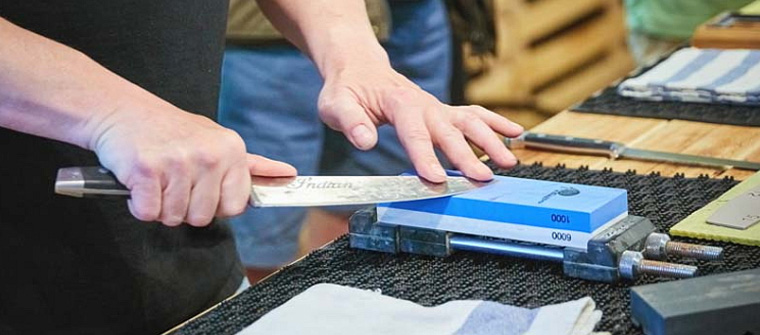
Sharpening a Kitchen Knife
For sharpening, we recommend using diamond and water whetstones. If you are not 100% sure of your skills, please contact us. We can sharpen your knives individually according to your wishes. We also regularly organize knife sharpening courses. Alternatively, seek a professional sharpener in your area. Damage caused by improper sharpening is irreversible.
Cleaning a Kitchen Knife:
Particles of aggressive substances attached to the blade surface can begin to corrode and create spots that look like rust. However, it is not the knife edge itself rusting, but these attached particles. For removal, baking soda is commonly used, which creates a "paste" when wet, along with an old cork stopper.
Dellinger Guarantee
Products supplied by Dellinger come with a 100% satisfaction guarantee. We guarantee an excellent product that will provide you with the best service, proven by many satisfied customers. Each piece can become a thoughtful gift for birthdays, weddings, or Christmas. Every product offered by Dellinger is carefully inspected. We bring you a lifetime warranty against any hidden defects. If you have any questions, our team is fully at your disposal and will try to help you in any situation.Additional parameters
| Category: | MUKASHI-NAGARANO Series |
|---|---|
| Warranty: | 2 years |
| Weight: | 0.145 kg |
| EAN: | 4956856724231 |
| čepel: | ocel 3 vrstvá |
| ? délka ostří: | 151-200 mm |
| typ rukojeti (střenky): | oválná - asijský typ |
| typ nože: | Nakiri - na zeleninu |
| production: | Japan |
| čepel: | ocel 3 vrstvá |
| délka ostří: | 201-250 mm |
| typ rukojeti (střenky): | ergonomická - západní typ |
| typ nože: | Chef / Gyuto |
| série: | Suncraft SENZO PROFESSIONAL SG2 Powder Steel |
| Gravírování: | ANO, obrázek +200 Kč |
Kanetsune Seki – Kitasho Co., Ltd.
Traditional Japanese knives and cutting tools from Seki in Gifu Prefecture. Kanetsune Seki combines the history of Japanese blades, quality steels, precise sharpening and practical design for cooks, collectors and outdoor use.
Kanetsune Seki Japanese knives from the city of blades
Kanetsune Seki is a Japanese brand of knives and cutting tools by Kitasho Co., Ltd., based in Seki, Gifu Prefecture. Seki is one of Japan’s best-known blade-making centres and has been associated for centuries with samurai swords, kitchen knives, scissors and other blades.
Kitasho Co., Ltd. was founded in 1964, while the family roots in knife-related production, distribution and trade date, according to the brand, back to 1930. Kanetsune Seki follows both the long tradition of Seki and the experience of Japanese blades as practical working tools.
The Kanetsune range includes kitchen knives, outdoor knives, pocket knives, hunting knives, scissors and other cutting tools. In the kitchen category you will find traditional and universal shapes such as Gyuto, Santoku, Nakiri, Deba, Usuba, Petty and other specialised models.
#ShowMore#
Seki tradition
Seki is a historic centre of Japanese blade-making, associated with swords, kitchen knives, scissors and many other blades.
Kitasho Co., Ltd.
A Japanese company founded in 1964, with roots in knife goods trading dating back to 1930.
Kitchen knives
Gyuto, Santoku, Nakiri, Deba, Usuba, Petty and other shapes for home and more demanding kitchen work.
Wide range
In addition to kitchen knives, the brand also offers outdoor, pocket and hunting knives, scissors and other cutting tools.
Kanetsune Seki brand overview
| Area | Information |
|---|---|
| Brand | Kanetsune Seki |
| Company | Kitasho Co., Ltd. |
| Origin | Seki, Gifu Prefecture, Japan |
| Company founded | 1964 |
| Roots in knife goods trade | since 1930 |
| Focus | Kitchen knives, outdoor knives, pocket knives, hunting knives, scissors and cutting tools |
| Kitchen shapes | Gyuto, Santoku, Nakiri, Deba, Usuba, Petty and other specialised models |
| Materials by series | Stainless steels, multi-layer blades, Damascus constructions and traditional carbon steels |
| Selected steels in the range | VG-10, SG2, Aogami, Shirogami and other materials depending on the specific series |
Which Kanetsune Seki knife should you choose?
| Knife type | Suitable use | Who it suits |
|---|---|---|
| Gyuto | Universal chef’s knife for meat, vegetables, fruit, herbs and longer slicing strokes. | For customers who want one main Japanese chef’s knife. |
| Santoku | Versatile cutting of meat, fish, vegetables and fruit in a home kitchen. | For users looking for an easy-to-control all-purpose knife. |
| Nakiri | Precise vegetable, herb and fruit cutting and moving ingredients from the board. | For vegetable lovers and fans of Japanese ingredient preparation. |
| Deba / Ko-Deba | Fish work, cleaning, portioning and specialised kitchen preparation. | For customers who want to work with fish in a more traditional Japanese way. |
| Petty | Small vegetables, fruit, precise cuts, trimming and quick kitchen tasks. | As a practical companion to a Gyuto or Santoku. |
Selection recommendation
If you are choosing your first Kanetsune knife, start with a universal Santoku or Gyuto. If you already have a main chef’s knife, add a Nakiri for vegetables, a Petty for precise cuts or a Deba / Ko-Deba for fish work.
Selected Kanetsune series and products on Dellinger.cz
| Product or series | Code / series | Characteristics | Price from |
|---|---|---|---|
| Japanese Gyuto/Chef knife 210 mm Kanetsune KC-950 Tsuchime Series | KNTN-KC-957 | Universal chef’s knife from the KC-950 Tsuchime series with DSR-1K6 steel. | 1 699 Kč |
| Japanese Santoku knife 165 mm Kanetsune KC-950 Tsuchime Series | KNTN-KC-952 | Versatile Santoku with Tsuchime surface and Japanese DSR-1K6 stainless steel. | 1 399 Kč |
| Japanese Gyuto knife 210 mm Kanetsune KC-200 Series | KNTN-KC-202 | Gyuto with a VG-10 core placed between 33 layers of Damascus steel. | 3 177 Kč |
| Japanese Santoku knife 165 mm Kanetsune Tsuchime VG-1 Series Mirror Polish | KNTN-KC-943 | Santoku with VG-1 stainless steel core SUS410 cladding and Tsuchime surface. | 2 799 Kč |
Craftsmanship and materials
Kanetsune Seki knives combine modern manufacturing precision with attention to blade geometry, edge grinding, knife balance and comfortable grip. Individual series differ in blade construction, steel type, hardness, edge shape and handle material.
The range includes stainless steels for easier maintenance, multi-layer blades, Damascus constructions and traditional carbon steels. Selected models use materials such as VG-10, SG2, Aogami or Shirogami, valued for sharpness, hardness and the ability to take a very fine edge.
Handles differ by model series. Kanetsune uses both traditional Japanese wooden handles and more modern Western-style constructions. Selected knives feature materials such as magnolia, rosewood, pakka wood or composite materials.
Care for Kanetsune Seki knives
As with most quality Japanese knives, proper maintenance is important. We recommend washing Kanetsune knives by hand, drying them immediately after use and not storing them loose in a drawer without edge protection. Carbon and multi-layer blades should be protected from moisture.
- Hand washing: do not wash the knives in a dishwasher and dry them immediately after use.
- Suitable cutting board: use a wooden or high-quality plastic board, not glass, stone or ceramic.
- No hard ingredients: do not use Japanese kitchen knives on bones, hard or frozen foods unless they are explicitly designed for it.
- Edge protection: use a sheath, saya, magnetic holder, block or edge guard.
- Sharpening: water sharpening stones are ideal for maintaining sharpness.
- Blade oil: for more sensitive blades and longer storage, use a very thin layer of protective oil.
Kitchen knives
Need advice choosing a Kanetsune knife?
We will be happy to help you choose the right shape, steel, sharpening method and accessories for caring for a Japanese knife. Contact us at +420 702 049 048, Mon - Fri, 7:30 - 16:00.
Frequently asked questions about Kanetsune Seki
1. Where does the Kanetsune Seki brand come from?
Kanetsune Seki comes from Seki in Gifu Prefecture, Japan.
2. Who is behind Kanetsune Seki?
The brand is backed by Kitasho Co., Ltd., founded in 1964.
3. Why is Seki important?
Seki is one of Japan’s best-known blade-making centres and has been associated for centuries with swords, kitchen knives, scissors and blades.
4. What types of kitchen knives does Kanetsune offer?
The range includes Gyuto, Santoku, Nakiri, Deba, Usuba, Petty and other specialised Japanese shapes.
5. Does Kanetsune offer only kitchen knives?
No. In addition to kitchen knives, it also produces outdoor, pocket and hunting knives, scissors and other cutting tools.
6. What steels appear in Kanetsune knives?
Depending on the series, the range includes stainless steels, multi-layer blades, Damascus constructions and traditional carbon steels. Selected models use VG-10, SG2, Aogami or Shirogami.
7. Are Kanetsune knives dishwasher safe?
No. Quality Japanese knives should be washed by hand, dried immediately and stored with protected edges.
8. How should Kanetsune knives be sharpened?
Water sharpening stones are ideal for maintaining sharpness. Depending on the knife and steel, a suitable ceramic or diamond honing rod can also be used for fine maintenance between sharpenings.
9. Who are Kanetsune knives suitable for?
For home cooks, professionals, lovers of Japanese knives and collectors looking for functional cutting performance, traditional character and a wide choice of models.
10. Which Kanetsune knife should I choose first?
As a first knife, we recommend a universal Santoku or Gyuto. Nakiri is mainly for vegetables, Petty for smaller ingredients and Deba / Ko-Deba for fish work.
| Manufacturing company : | KITASHO CO., LTD. |
|---|---|
| Address : | 5-1-11 Sakae Machi |
| E-mail : | aiba@kt-kitasho.co.jp |
| EU representative of the manufacturer : | Dellinger s.r.o. |
| Address of the EU representative : | Rižská 1580/7, 102 00 Praha |
| Email of the EU representative : | saleseu@dellinger.cz |