
Both shapes handle boneless meat, vegetables, fruit, fish and everyday home cooking. Santoku is shorter, more agile and easy to control. Gyuto offers a longer blade, a more pronounced tip and a wider range of uses. We will help you decide which one better suits your cutting style.
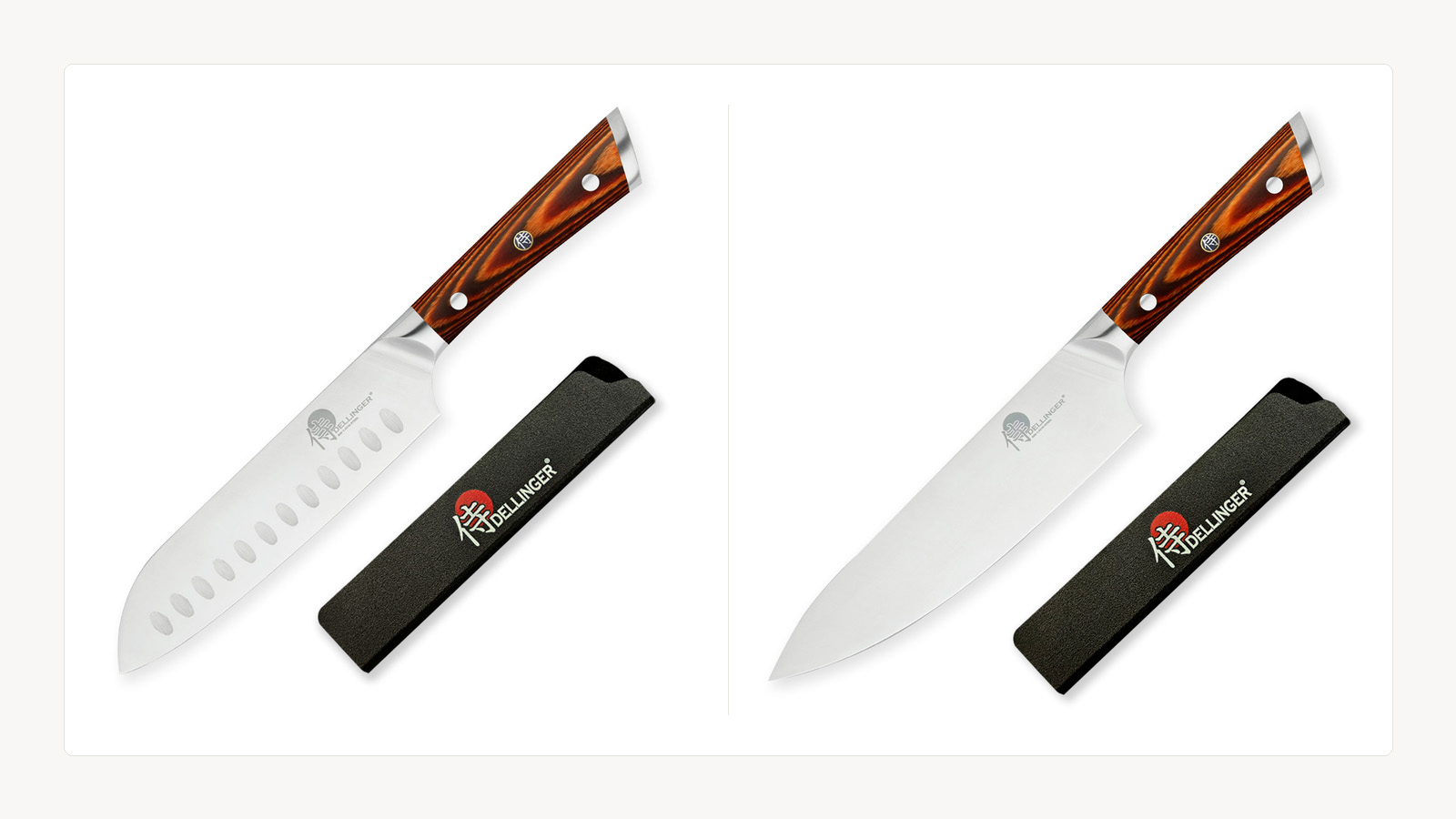
Santoku or Gyuto?
If you are unsure where to start, choose according to the size of the ingredients, the space on your cutting board and the motion you use most often when cutting.
Choose Santoku
Most commonly 165–180 mmSantoku will suit you if:
- you cook normal household portions,
- you often cut vegetables, herbs and fruit,
- you work on a smaller cutting board,
- you want a shorter, easy-to-handle knife,
- you mainly use an up-and-down cutting motion.
Choose Gyuto
Most commonly 200–210 mmGyuto will suit you if:
- you want one main chef's knife,
- you often cut larger pieces of meat and vegetables,
- you use longer slicing or rocking cuts,
- you will benefit from a more pronounced and precise tip,
- you have a sufficiently large cutting board.
Simple rule: Choose Santoku for agility and everyday home preparation. Choose Gyuto for larger ingredients, longer cuts and broader culinary use.
The quick answer: Santoku or Gyuto?
Santoku is recommended for customers who want a compact all-purpose knife for quick everyday preparation. The shorter, wider blade is easy to control when cutting vegetables, herbs, fruit, fish and smaller portions of boneless meat.
Gyuto is better suited as the main chef's knife for a wider range of tasks. The longer blade handles large ingredients, bigger pieces of meat and smooth slicing cuts more effectively. Its more pronounced tip also makes precise work easier.
The question is therefore not which shape is generally better. What matters is which knife suits your space, ingredients and cutting technique.
What is a Santoku?
Santoku is a Japanese all-purpose kitchen knife. Its name is usually translated as “three virtues” or “three uses” – meat, fish and vegetables.
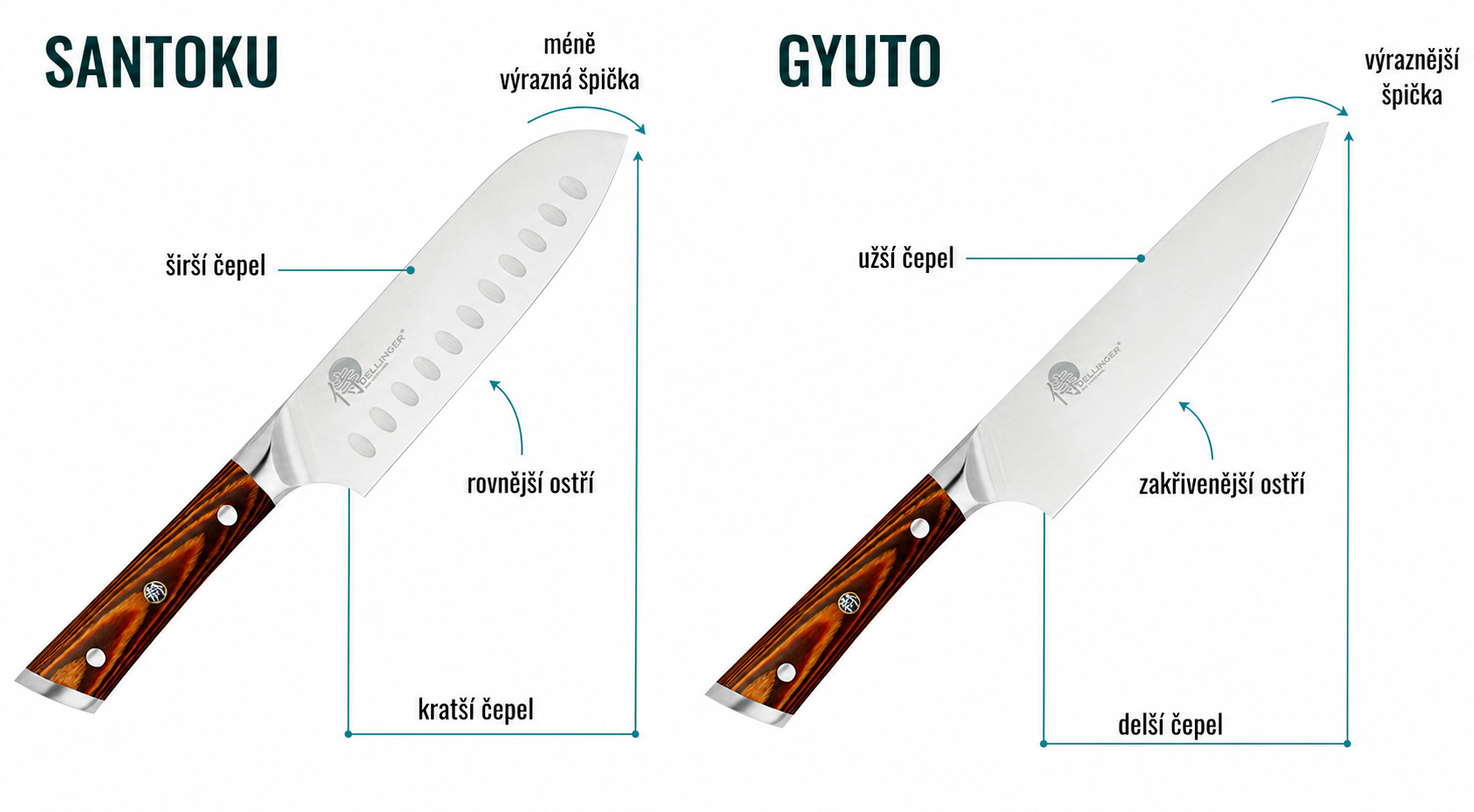
A typical Santoku has a blade approximately 160–180 mmlong, with a wider profile, a less pronounced tip and a relatively straight cutting edge. This makes it comfortable for cutting vegetables, onions, herbs, fruit and boneless meat.
The wider blade can also be used to transfer chopped vegetables from the cutting board. However, scoop ingredients with the spine of the blade so that the edge does not become unnecessarily dull.
What is a Gyuto?
Gyuto is the Japanese form of the classic chef's knife. Although its name historically refers to a beef knife, today it is a versatile tool for meat, vegetables, herbs, fruit and fish.
For the home kitchen, a very practical length is 200–210 mm. Gyuto is usually longer and slimmer than Santoku, with a more pronounced tip and a smoother curve to the edge.
The length supports slicing cuts and working with larger ingredients. The curvature of the edge also allows a rocking motion if the specific blade profile and your technique support it.
Key differences: Santoku vs. Gyuto
| Feature | Santoku | Gyuto |
|---|---|---|
| Typical role | Compact household all-rounder | Main chef's knife |
| Typical length | 160–180 mm | 200–240 mm |
| Blade shape | Wider and more compact | Longer and usually slimmer |
| Tip | Less pronounced | More pronounced for precise work |
| Edge profile | Usually straighter | Usually more curved |
| Cutting technique | Up and down, short stroke | Longer stroke and rocking motion |
| Feel in use | Control and agility | Reach, smoothness and performance |
| Workspace | A smaller cutting board is sufficient | Works better on a larger cutting board |
| Greatest advantage | Easy handling | Versatility and cutting length |
Choose a knife according to your kitchen workflow
The best choice is not determined by the knife's name alone. More important is the size of the portions you prepare, the size of your cutting board and the motion with which you guide the blade.
Smaller household portions
For vegetables, herbs, fruit, chicken and quick everyday cooking, Santoku will generally be more comfortable.
Larger ingredients
For cabbage, melon, large onions, roasts or larger pieces of meat, Gyuto offers more space and a longer cut.
Up-and-down motion
The straighter Santoku profile supports controlled cutting with frequent contact between the edge and the cutting board.
Slicing and rocking
The longer, more curved Gyuto blade is better suited to smooth slicing and rocking motions.
Which knife is better for vegetables?
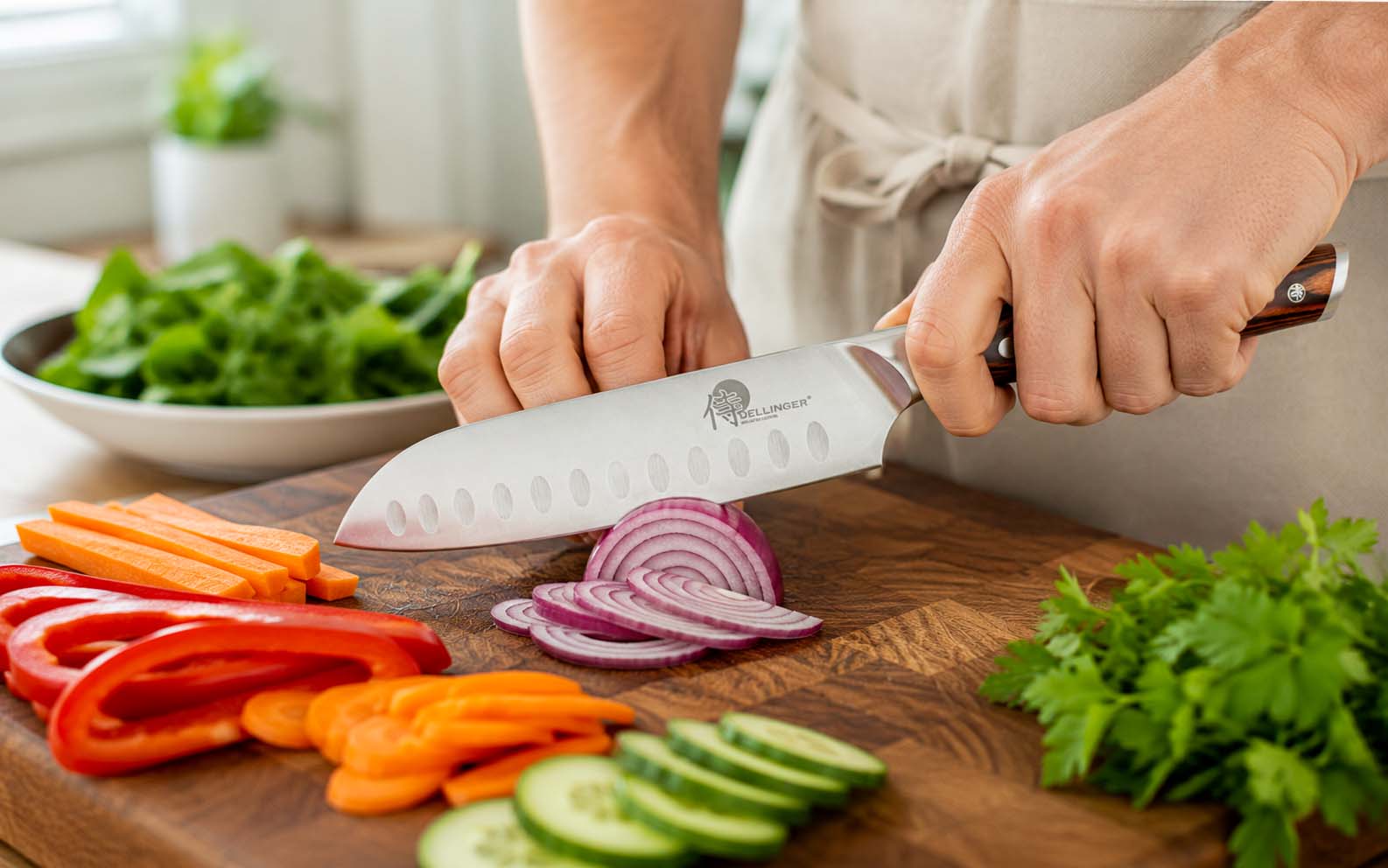
For small and medium-sized vegetables, Santokuis usually more comfortable. Its wider blade, straighter cutting section and compact length work well when preparing onions, carrots, peppers, cucumbers, mushrooms or herbs.
If you often cut cabbage, pumpkin, melon or larger root vegetables, Gyutomay be more practical. The longer blade provides a larger cutting area and allows you to pass through the ingredient with a smoother stroke.
Which knife is better for meat?
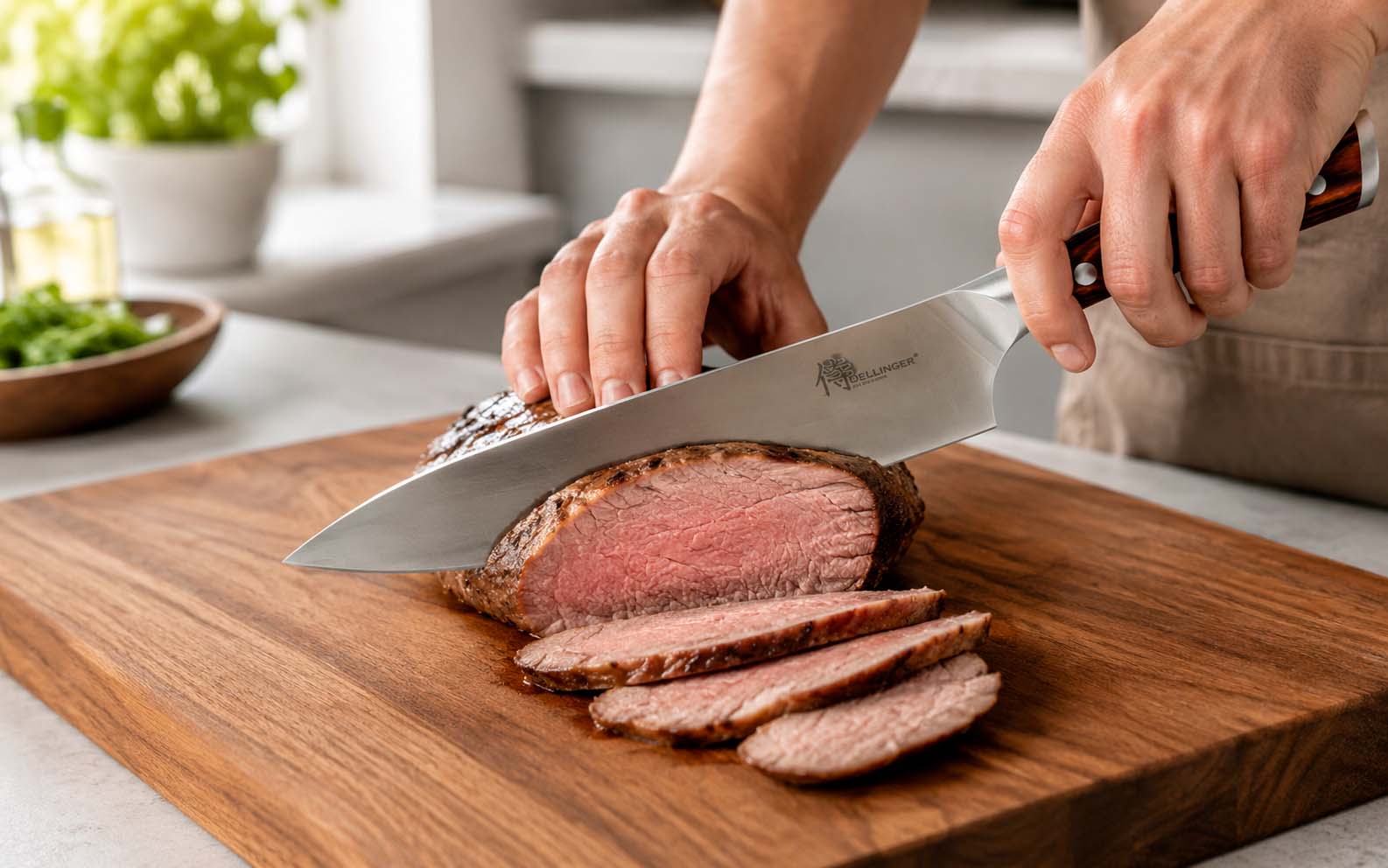
Both shapes handle ordinary boneless meat well. Santoku is agile when preparing chicken breasts, smaller slices or meat cut into strips.
Gyuto has the advantage with larger pieces. The longer blade is suitable for smooth portioning of steaks, roasts and larger slices. The more pronounced tip helps with trimming and precise cuts.
Which knife is more suitable for a beginner?
For most beginners, a Santoku around 165–180 mm will feel more comfortable. The shorter blade requires less space, is easy to control and works well with a simple up-and-down cutting motion.
If you already cook regularly, have a larger cutting board and are looking for one main knife with room to grow, you can start directly with a Gyuto around 200–210 mm.
What would Marek Šmíd choose?
“If I were choosing a first quality kitchen knife for an ordinary household today, I would recommend a Santoku around 170–180 mm. It is easy to handle and covers most everyday tasks. But if you cook often, cut larger ingredients and want one main chef's knife, I would choose a Gyuto around 210 mm.”
Marek Šmíd – specialist in Japanese knives ›Which blade length should you choose?
Santoku 165–180 mm
The most versatile range for home use. Shorter models are very agile, while longer ones offer more space for medium-sized ingredients.
Gyuto 200–210 mm
A practical compromise between handling and cutting length. A good choice for one main chef's knife.
Gyuto 240 mm and longer
For more experienced users, large ingredients, a larger workspace and long, smooth cuts.
What about balance?
Thanks to its shorter blade, Santoku often feels compact and stable. This helps when repeatedly cutting vegetables, herbs and smaller ingredients.
Because of its longer blade, Gyuto may have its balance point shifted further forward. During a longer slicing cut, this can feel natural and help the blade pass smoothly through the ingredient. The final feel also depends on the handle design, materials and the specific model.
Santoku or Gyuto as a gift?
If you do not know the recipient's cooking style exactly, Santoku is usually the safer, more universal choice. It is easy to control, does not require an exceptionally large cutting board and suits most households.
Gyuto is an excellent gift for someone who cooks often, uses a classic chef's knife and appreciates a longer blade. Before buying, it is worth finding out what length of knife they currently use and whether they have a sufficiently large work surface.
Do you need both knives?
Certainly not to begin with. One quality knife that suits your cooking style is more useful than a large set of shapes you hardly ever use.
If you enjoy cooking, however, Santoku and Gyuto complement each other well. You can use Santoku for quick everyday preparation, vegetables and herbs. Gyuto takes over larger ingredients, longer cuts and more demanding kitchen work.
What should you focus on besides shape?
A knife's performance is not determined solely by whether it is called Santoku or Gyuto. The combination of material, grind, geometry, handle and overall workmanship is important.
How should you care for Santoku and Gyuto?
Proper care determines how long the knife will continue to cut well. The basic rules are the same for both shapes.
Daily care
- wash the knife by hand, never in a dishwasher,
- dry it immediately after washing,
- do not cut on glass, stone or plates,
- do not chop bones or frozen food,
- do not use the knife for prying or as a screwdriver.
Cutting board, storage and sharpening
- use a wooden, composite or suitable plastic cutting board,
- store the knife in a block, sheath or on a magnetic holder,
- check the edge regularly,
- use a suitable sharpening stone or professional sharpening to restore the edge.
Santoku for control, Gyuto for a wider range of work
For most households, Santoku is an excellent first quality knife. It is easy to control, takes up little space and handles most everyday preparation.
Choose Gyuto if you want one main chef's knife, work with larger ingredients or prefer longer slicing and rocking cuts. If you cook often, the two shapes complement each other very well.
Frequently asked questions: Santoku vs. Gyuto
1. Is Santoku better than Gyuto?
Not in general. Santoku is better suited to shorter, quick and well-controlled cutting. Gyuto offers a longer cut, a more pronounced tip and a wider range of uses.
2. Can Santoku replace a chef's knife?
Yes, in most households it can serve as the main all-purpose knife. However, when frequently cutting large ingredients, Gyuto may offer more space.
3. Is Gyuto suitable for a beginner?
Yes, especially at a length of around 200–210 mm. In a small kitchen or on a smaller cutting board, however, a shorter Santoku may be more comfortable.
4. Which knife is better for vegetables?
Santoku is very pleasant for small and medium-sized vegetables. For cabbage, pumpkin, melon and other large ingredients, a longer Gyuto may be more practical.
5. Which knife is better for meat?
Both handle boneless meat. Santoku is suitable for smaller portions and strips, while Gyuto is better for large pieces, steaks and roasts.
6. Which knife is better for herbs?
Santoku offers good control when cutting up and down. If you process herbs with a rocking motion, a more curved Gyuto may suit you better.
7. What Santoku length should you choose?
For most households, we recommend approximately 165–180 mm. A shorter blade is more agile, while a longer one handles medium-sized ingredients better.
8. What Gyuto length should you choose?
The most versatile choice for home use is approximately 200–210 mm. A length of 240 mm or more is suitable for a larger work surface and more experienced users.
9. Which knife is more suitable as a gift?
If you do not know the recipient's cooking style, Santoku is usually the more versatile and easier-to-handle choice. Gyuto will please someone who cooks often and appreciates a longer chef's blade.
10. Do I need both Santoku and Gyuto?
To begin with, one well-chosen knife is enough. With frequent cooking, however, they complement each other well: Santoku for quick preparation and Gyuto for larger ingredients and longer cuts.
Specialist in Japanese knives, EDC knives and katanas.
View author profile ›